Victoria Falls changes by the hour, and the shot you share online or look back on with friends and family depends on the time of day, the season, the weather and where you stand.
In harsh light or heavy spray, the Falls can lose definition and appear as a wall of white; in the right conditions, you might capture a rainbow through the spray, detail in the gorge or the river reflecting the colours of dawn.
To help you get the best shot, the tips below cover when to shoot, where to stand, what to carry and rules on drones.

Best Times for Light
At Victoria Falls, good waterfall photography begins with timing rather than gear.
Early morning and late afternoon generally offer softer, more directional light, but the best position depends on the season and the viewpoint. Spray, wind and cloud can change visibility within minutes, particularly during high water season.
Midday light is harsher, although it can still produce strong rainbows when the sun is in the right position. For the best chance of seeing a rainbow, keep the sun behind you and be prepared to move along the trail as the light moves.
The river generally rises from February, staying high and dramatic through into the summer, sometimes lasting as late as July. At its highest, the spray plume can rise to around 500 metres. It’s the most dramatic version of the Falls, but also the hardest to photograph. Devil’s Cataract and Main Falls can disappear behind mist for days at a stretch, and a lens without proper protection won’t last long out there.
Zimbabwe’s rainy season runs from November to April. February, March and April are the trickiest months for photography specifically — even as the river builds to ward its most dramatic, cloud cover and rain can flatten the light and obscure the view for days at a time. For the most reliable conditions with a still-powerful curtain, aim for April into May, once the rains have cleared.
From August, water levels generally fall and visibility improves, reaching their seasonal low around early November. The Zimbabwean side, including Devil’s Cataract and much of Main Falls, tends to retain more water into the dry season, although flow varies from year to year.

Where to Shoot
The Falls themselves, and the walking trail covered below, sit inside Rainforest National Park on the Zimbabwean side. If you’d rather see the Falls from the river, with a more distant view of the spray, a river cruise through Zambezi National Park is the better option. (View our River Cruises here)
The Zimbabwean rainforest trail winds past a series of numbered viewpoints but the four best spots are: Devil’s Cataract, Main Falls, Horseshoe Falls, and Rainbow Falls. Each one can be reached on foot and frames a different section of the drop.
Devil’s Cataract is the first major section encountered from the Zimbabwean entrance and offers a close, dramatic view, with spray rising behind it.
The Main Falls viewpoints reveal the broadest and most powerful central section of the curtain and generally suit a wide-angle lens.
Horseshoe Falls is next, roughly halfway along the trail. It curves into a tight U shape. From nearby viewpoints, try shooting along the curve to create greater depth than a straight-on composition.
Rainbow Falls lies toward the eastern end of the Zimbabwean trail, near the bridge viewpoints. Rainbows depend on the sun, spray and your position, and tend to show strongest in the early morning or mid-afternoon, roughly 2–4pm, particularly on the Zimbabwean side, where spray holds even outside the high-water months.
A guided tour of the Falls is on foot, through the Rainforest National Park, and usually starts at 9am, though experienced guides will take photographers out earlier, from 6:30am, to catch the low light and the mist before the trail fills up. Rainforest National Park entry fees are generally billed separately from tours, so remember to factor that in.
For the best photography on the Zambezi, nothing beats getting onto the water itself.
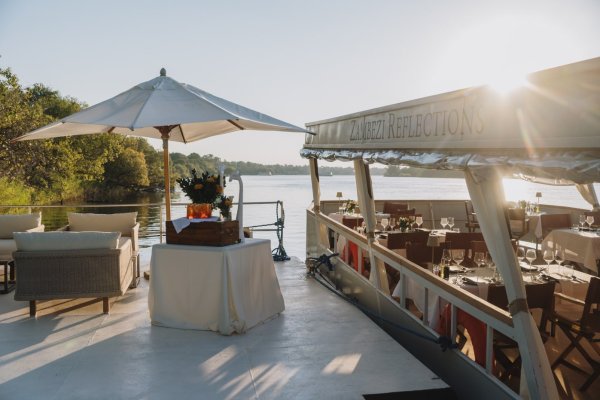
Our river cruises put you level with the river as the light shifts, whether that’s the mist burning gold at dawn on a sunrise cruise, or the sky running copper to violet as hippos surface for the evening on a sunset cruise.
From the river, you can photograph reflections, islands, wildlife and the distant spray cloud – an altogether calmer perspective than the rainforest trail.

What Gear to Carry
Spray is the main thing to plan around, more than light or lenses; on a high-water day you can get soaked from several hundred metres out. Therefore, a rain cover for your camera and a dry bag for anything you’re not actively using are both essential during high water season. A microfibre cloth you can reach for is also a great addition.
A wide-angle lens is useful at the closer viewpoints, where fitting the scale of the Falls into one frame can be difficult. A standard zoom remains versatile, while a short telephoto is useful for isolating details and compressing the gorge walls.
Whatever you’re carrying, a phone will get you through the wide shots and the sunset cruise just fine. It’s the close, textured detail of the spray and the rock that rewards a proper camera. Keep spare batteries somewhere dry and warm: the humidity along the rainforest trail drains them faster than you’d expect.

Drone and Park Considerations
Drone use at Victoria Falls requires advance authorisation and should not be treated as a casual recreational activity. On the Zimbabwean side, operators must comply with the Civil Aviation Authority of Zimbabwe’s registration, licensing and operational requirements; bringing a drone into the country may also require pre-clearance. Separate permission may be required to operate or film within Victoria Falls National Park.
On the Zambian side, approval must be obtained through the Zambia Civil Aviation Authority, which publishes separate RPAS registration and operational-approval procedures. Additional permission may be required for filming or operating within the Mosi-oa-Tunya/Victoria Falls protected area.
Requirements, restricted airspace and fees can change. Contact the relevant civil aviation authority and park or heritage authority well before travelling, and do not bring or launch a drone on the assumption that permission can be arranged on arrival.

Frequently Asked Questions
What is the best time for photos?
Early morning and late afternoon generally offer the softest light, although rainbow position depends on the viewpoint and the direction of the sun. For clearer views and less spray, consider the lower-water months from August into early November; for the most powerful curtain, visit between April to July, once the rains have cleared and the water is still running high. Conditions vary from year to year, so check current Zambezi flow levels before travelling.
Can drones be used?
Only with advance authorisation. Requirements differ between Zimbabwe and Zambia and can include registration, pilot or operator approval, import clearance and permission from the authority responsible for the protected area. Check directly with the relevant civil aviation and park or heritage authorities before travelling.
What are the top viewpoints?
Devil’s Cataract, Main Falls, Horseshoe Falls, and Rainbow Falls, all reached via the Rainforest National Park walking trail on the Zimbabwean side. Each frames a different angle on the Falls, so it’s worth walking all four rather than stopping at the first good view.